
Xi Story: When lush mountains become a measure of governance
In August 2005, sweltering heat hung over a hilly village in east China. Inside a modest meeting room, an air conditioner hummed against the summer heat as Xi Jinping, then chief of the Zhejiang provincial committee of the Communist Party of China (CPC), met local officials during an inspection tour.
Yucun Village in northern Zhejiang had made a painful yet pivotal choice: shutting down three quarries and a cement plant that had long been its economic lifeline.
In the 1990s, the village had prospered on limestone mining and cement production, but at a visible cost: hillsides were carved open, streams had turned murky and dust constantly hung in the air.
The economic impact of the closures was immediate. As incomes fell, growing discontent from the villagers placed mounting pressure on local officials.
When village Party chief Bao Xinmin reported the decision to Xi, the atmosphere in the room was tense. At a time when economic development, mostly measured by GDP growth, dominated official performance evaluation, abandoning lucrative industries was no easy choice.
Sensing the concern among the village officials, Xi asked why the quarries and the plant were shut down.
Pollution had become unbearable, Bao replied. « Years of mining and lime production left our village constantly covered in dust and thick smoke. It felt as if we were living in a toxic cage, » he said.
« Your decision is a wise choice! » Xi said, to everyone’s surprise.
« Every choice comes with gains and losses. When you can’t have it both ways, you need to know what to give up and what to choose. Development can take many forms, but it must be sustainable, » he said.
It was then that Xi put forward what would later become one of China’s best-known environmental concepts: « Lucid waters and lush mountains are invaluable assets. »
Such thinking emerged from Zhejiang’s own realities. As one of China’s coastal provinces, Zhejiang was among the early movers in dealing with the tension between short-term economic gain and long-term ecological sustainability.
Xi’s tenure in Zhejiang from October 2002 to March 2007 was also a pivotal transformation period for the province’s development. While Zhejiang maintained steady economic progress, the problems stemming from its extensive growth model were looming large, in the form of tight land supply, worsening pollution and severe power shortages resulting from over-dependence on resource-driven investment.
At the height of the energy crunch, in some rural parts of Zhejiang, power was only available half the week. More than 50 percent of enterprises had experienced power outages. Many businesses, and even ordinary households, had to install their own generators.
After a series of field visits, Xi in 2003 unveiled a development blueprint in which ecological advancement was given a prominent place.
This overarching plan guided local cadres to recalibrate their views on governance achievement.
Sun Wenyou, then Party secretary of the city of Huzhou, recalled that Xi stressed on multiple occasions that short-term economic gains must never come at the expense of the environment, nor should officials seek vanity projects to polish their performance records.
Li Jinming, a former deputy Party chief of Zhejiang, recalled that Xi cautioned against overemphasis on GDP growth as the sole criterion for officials’ performance, stressing that what mattered most to ordinary people was tangible improvements in livelihoods.
Improving the ecological environment, Xi argued, is a form of developing productive forces.
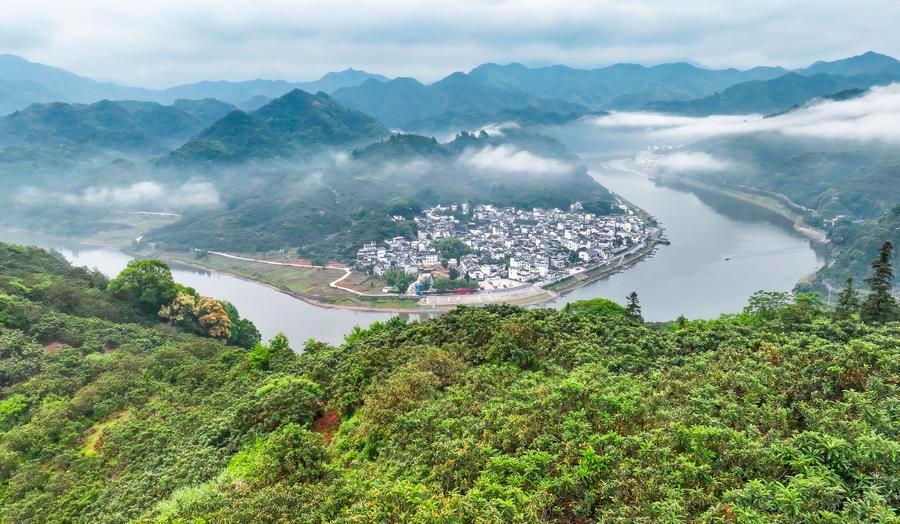
This idea found its clear expression in Yucun. The former cement plant site was turned into green fields. As environmental conditions improved, villagers began opening guesthouses and farm stays.
What began in Yucun has come to reflect a provincial and then national shift in development philosophy, embedding green principles into the pursuit and evaluation of development.
After assuming the top office as the general secretary of the CPC Central Committee in 2012, Xi made ecological civilization a national priority. China launched a series of far-reaching environmental initiatives, expanding both the scope of regulation and the capacity to enforce it.
Environmental performance has also become an important criterion in cadre evaluation. Central government environmental inspections have prodded local officials to place greater emphasis on ecological protection.
After years of smog and severe air pollution, blue skies are now the new normal in China. In 2025, 89.3 percent of the days in the year recorded good or excellent air quality, the highest level ever recorded.
By championing green development, China has also recorded the world’s fastest growth in forest resources, taken a global lead in renewable energy development, and achieved one of the fastest reductions in energy intensity worldwide.
To underpin such progress, China’s top legislature in March this year adopted a landmark Ecological and Environmental Code, laying a solid legal cornerstone for pursuing Chinese modernization with human-nature harmony as one of its distinctive features.
When Xi revisited Yucun in 2020, he found a village transformed, with verdant hills, crystal-clear streams, tidy roads and rows of modern homes. Ecotourism projects were flourishing, and villagers were earning decent incomes.
Xi looked back on the village’s green transformation and said its experience had proved that green development was the right path.
« Once the right direction has been chosen, it should be pursued with determination, » Xi said. ■
by Xinhua