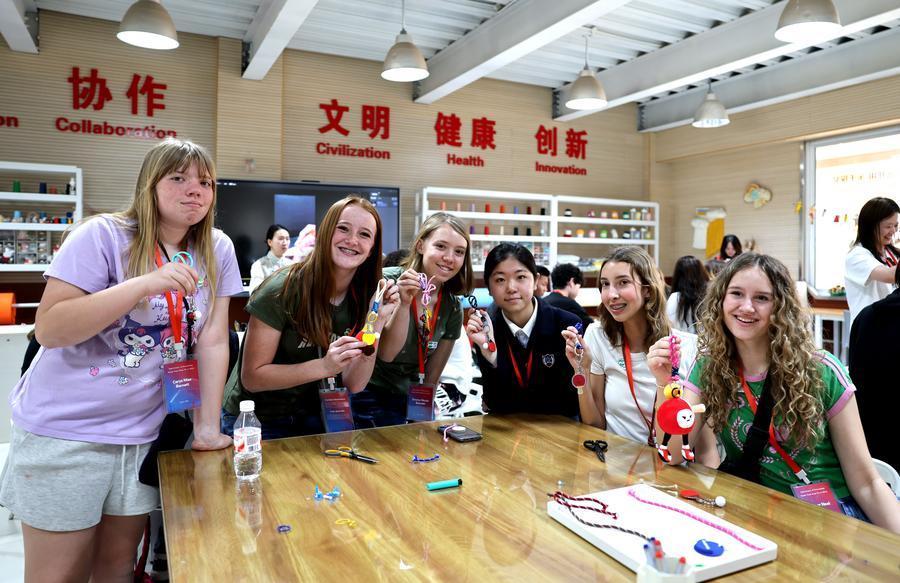

►► Out at sea, Chinese and U.S. university students explored the ocean, took part in scientific and cultural activities and, at one point, sat down to negotiate a global environmental problem.
BEIJING-Taking on the roles of different countries and international organizations, 20 students, 10 from each country, worked on solutions to mercury pollution in the oceans. When one American student joked that they might have to leave the ship if they couldn’t reach an agreement, the group erupted in laughter, recalled Zhou Xinyi, then a student representative from Tsinghua University.
Zhou and her fellow students were participating in a program aboard the China-U.S. Youth Friendship vessel, which sailed from Hong Kong via Ningbo to Shanghai earlier this year. For them, the experience offered more than a journey across the sea — it was an opportunity to learn, work together and build friendships.
The voyage was one of many exchanges under an initiative China announced in November 2023 to invite 50,000 young Americans to China for exchange and study over five years, an effort to encourage them to learn about China as it really is and help build people-to-people ties.
Since the initiative was launched, youth exchanges between the two countries have grown in both scale and variety. Many young Americans have come to China for exchanges and study, building friendships and helping strengthen ties across the Pacific.
With efforts from various parties, the goal was reached two and a half years ahead of schedule earlier this year, with more than 50,000 young Americans from all 50 U.S. states and Washington, D.C., visiting China.
They left footprints in all 31 provincial-level regions on the Chinese mainland, as well as Hong Kong and Macao, taking part in cultural experiences, language learning, academic programs, science and technology exchanges and sports activities, according to China’s Ministry of Education.
Meredith Kime, a PhD candidate in Earth and Environmental Sciences at Columbia University, who was also aboard the China-U.S. Youth Friendship vessel, said: « I wanted to come on this incredible journey, collaborating with students from the United States and China, enjoying friendship and our shared experience. »
Kime added that the initiative to invite 50,000 young Americans to China over five years has created a bridge for youths from the two countries to connect, giving real friendships a chance to grow.
GROWING MOMENTUM
Reaching the goal ahead of schedule reflects young Americans’ strong desire to experience China firsthand and the powerful momentum for people-to-people exchanges, said Diao Daming, vice dean of the National Academy of Development and Strategy of Renmin University of China.
The initiative is more than a numerical target. It has created a long-term, stable and sustainable platform for youth exchanges between the two countries, said David Chong, founder and president of the U.S.-China Youth and Student Exchange Association.
Many young Americans who took part in exchange programs have continued to follow developments in China after returning home and some have taken up learning Chinese, while others have continued to promote exchanges between schools, he said.
Wang Yijie, founder of Noice China, which organizes trips to China for U.S. students, has noticed the rising enthusiasm among U.S. students for visiting China.
« Our team is really busy because we are hosting more groups this year, » she said. « Spots for a recent trip involving about 160 Harvard students sold out in less than a minute. »
Wang said students who visit China often return home and encourage people around them to experience the country for themselves. The message they pass on to their friends and family is simple: « You have to go. »
The growing number of youth exchange programs shows that China’s rapid development, particularly in emerging technologies, has drawn greater attention from young people, driving a rising interest in the country, she noted.
More opportunities created by the initiative, along with more convenient travel policies, have made it easier for students to visit China.
Many programs are now driven less by marketing than by recommendations within close-knit student networks, she said.
LEGACY OF PEOPLE-TO-PEOPLE TIES
History has shown that time and again, individuals on both sides have reached out to one another and helped put bilateral ties back on track during challenging periods.
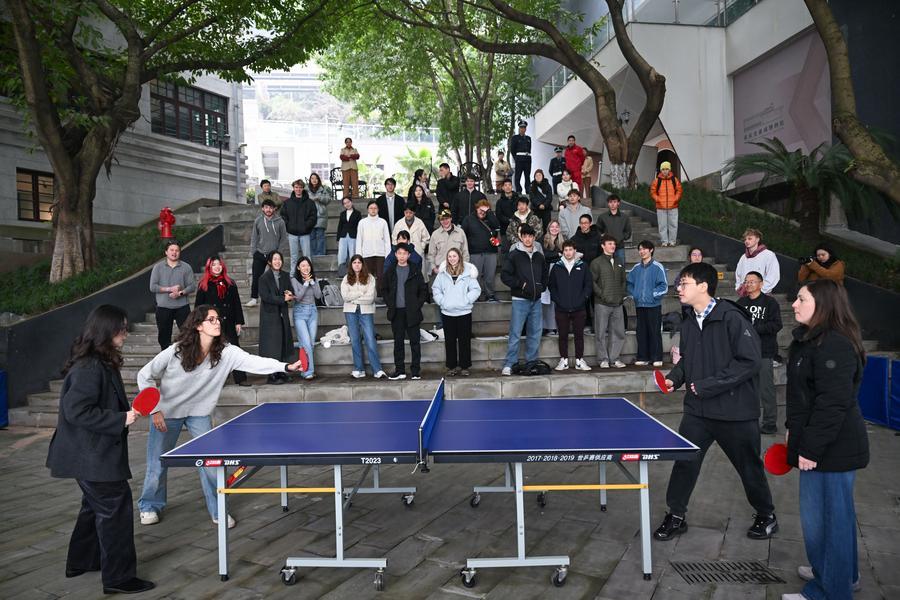
More than half a century ago, a small table tennis ball paved the way for the normalization of China-U.S. relations. This year marks the 55th anniversary of Ping-Pong Diplomacy, and a series of commemorative events have been held across the Pacific to carry on the spirit.
Judy Hoarfrost, the youngest member of the U.S. table tennis delegation to China back in April 1971, returned to China to attend a commemoration ceremony in April this year and then led a U.S. pickleball delegation to China in May.
« Fifty-five years ago, that trip to China changed my life, » said Hoarfrost, who is 70. Now, seeing young people from the two countries playing and laughing side by side on the court, she said any relationship is built on friendship and trust.
« I think it’s really important to give youth those opportunities, because it’s only by really meeting each other that you can understand what you have in common, » Hoarfrost said.
By Xinhua