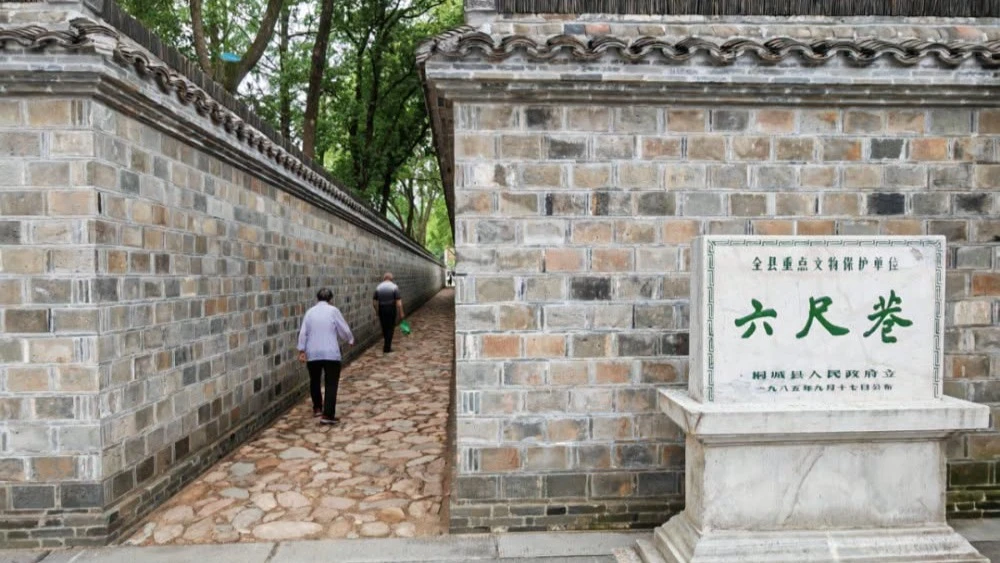

►►As shadows of tree leaves drift across the gray-brick walls of Liuchi Alley in Tongcheng City, east China’s Anhui Province, visitors take photos along the narrow lane, which is an example of neighborhood comity and harmony.
HEFEI-The alley is barely two meters wide, or six Chi. Chi is a traditional Chinese length unit that, under the modern market measurement system, equals approximately 1.09 feet.
The historical cultural site is known for the story of Zhang Ying, a first-rank Qing Dynasty (1644-1911) official, and his neighbor. To resolve a property boundary dispute, both sides voluntarily moved their courtyard walls roughly three feet backward, leaving a six-foot lane between their residences. It has stood as a centuries-old exemplary tale of mutual restraint, reciprocal respect and harmonious neighborly relations.
When Chinese President Xi Jinping visited the alley during an inspection tour in Anhui in October 2024, he paused before a wall recounting the story.
Xi noted that Liuchi Alley exemplifies the ancestral wisdom of dispute resolution and should serve as an educational site for carrying forward traditional Chinese culture, and that full play should be given to China’s traditional virtue of courtesy and modesty, so as to create a harmonious social environment where people can live and work in peace and happiness.
Zhang Yun, head of the Liuchi Alley community’s Party organization and a 12th-generation descendant of Zhang Ying, tells visitors how the alley came into being and draws on its values in community work.
He said Xi’s visit has deepened local residents’ identification with the alley. Its values now figure more prominently in how they manage community affairs. « Saying ‘I’m from Liuchi Alley’ carries a different weight now, » he said.
During the Anhui inspection, Xi also emphasized the need to strengthen the protection of historical and cultural heritage, as well as the promotion of creative transformation and innovative development of fine traditional culture.
Tongcheng has woven the values associated with the alley into community work and grassroots governance, using persuasion, empathy and compromise to help resolve disputes before they escalate.
That emphasis on accommodation, Zhang stressed, does not mean asking people to yield without principle. « It’s not simply giving way, still less forcing someone to do so, » he said. « It is a gesture — the stronger side takes the first step, while morality and law work together. »
The approach is also gaining broader institutional backing. On July 24, the Standing Committee of the Anhui Provincial People’s Congress adopted a decision on using the « Liuchi Alley work method » to improve grassroots governance, marking Anhui’s first provincial-level legislative move to promote the approach.
One place where the approach has taken practical form beyond neighborhood mediation is the Hefei railway station, which handles nearly 90,000 passenger arrivals and departures a day. The staff there have brought the ethos of the alley into daily passenger service, and a small mediation room allows travelers to calm down and talk through their differences.
One evening, the duty station master Lu Yong spotted a passenger lying across the seats while travelers carrying luggage stood nearby with nowhere to sit. Lu explained the station rules and asked him to consider others who were just as tired from their journeys. The passenger quickly made room, defusing a possible quarrel before it began.
In another case, two passengers became locked in an argument after a charger fell and struck one of them on the head. Lu brought them into the mediation room, heard both sides and confirmed that the injury amounted to only slight redness and swelling. After more than 30 minutes of mediation, one passenger apologized and agreed to cover the medical examination, and the injured traveler accepted the settlement.
Since opening in 2024, the mediation room has helped resolve more than 650 disputes.
Such mediation is never meant to supersede the law. The law defines rights, boundaries and bottom lines, while Liuchi Alley culture advocates accommodation and dialogue, said Peng Fenglian, a law professor at Anqing Normal University, stressing that there is no contradiction between them.
After more than three centuries, the alley is still making room in the everyday practice of resolving grassroots disputes.
By Xinhua